Showing posts with label INVENTED INSTRUMENTS. Show all posts
Showing posts with label INVENTED INSTRUMENTS. Show all posts
Wednesday, December 16, 2020

Sunday, November 29, 2020
Saturday, December 14, 2019


Thursday, August 22, 2019
invented instruments - the return's return
Terrain Instruments!
"This 1978 documentary [BELOW] with Leif Brush, in interview with Steward Turnquist, Coordinator of the Minnesota Artists Exhibition Program, is the first significant concise capturing and explanation of Leif Brush's work. With original footage (audio, video and photography), the team around producer/director Jerome Downes related the reasons and specificities why and how Leif ended up working with the Terrain Instruments. Technically and philosophical explained, we hear and see, and hear about three major Terrain Instruments: the 'Whistlers', 'Signal Disks' and 'Tree Harps.' A presentation of The Minneapolis Institute of Arts' Minnesota Artists Exhibition Program, in cooperation with the Minneapolis College of Art and Design and the Jerome Foundaction Inc. 27'33, color documentation, 1978; broadcasted at WDSE-TV in the same year; digitized from VHS in 2011"
Thursday, July 25, 2019
invented instruments (one more time)
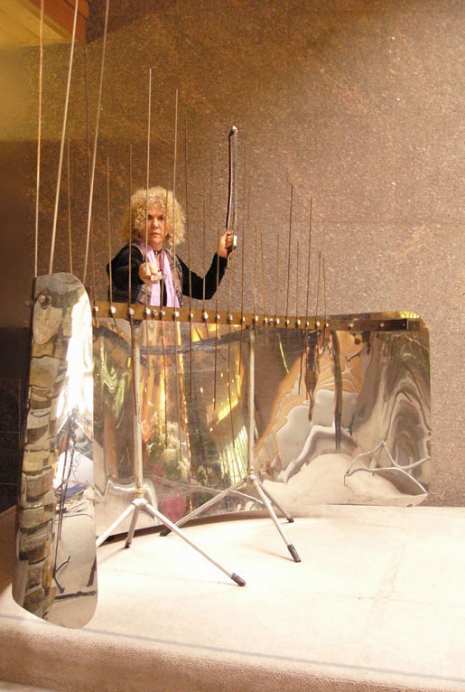
info from http://www.constancedemby.com/instruments_f.html
The Sonic Steel Space Bass
"A Transdimensional Communication Device"
The Sonic Steel Instruments, original designs by Constance Demby, have been recorded by Lucas SkyWalker Studios for use in their filmscores, and filmed by Discovery Channel in Gaudi's "Parc Guell" in Barcelona for their specials.
The Sonic Steel Space Bass is a 10 ft sheet of mirror finish stainless steel with 5 octaves of steel and brass rods. The rods can be bowed, struck percussively, and the metal sheet can be rubbed to create various effects. Several tones can be created by bowing a single rod, resulting in a multi-tiered overtone series. A sound scientist determined that the sound waves on the lowest notes of the instrument are approximately thirty feet long.
The instrument emits deep, primordial, archetypal resonances that put audiences into altered states in which listeners report transdimensional experiences. In healing modality, the ultra low sub-sonic frequencies have been known to break up and dissolve long held encrustrations held in the embodiment, resulting in healings. (see http://www.constancedemby.com/sonicimmersion.html )
ORIGIN OF THE SONIC STEEL INSTRUMENTS
From the artist: I had one-woman shows of my artwork and sculpture in Greenwich Village, NYC, in the 60s and 70s, as my creative pursuits have always extended beyond music to include painting, sculpture, and multi-media, and the steel instruments are the result of my combined love of sculpture and music.. At the time, I was about to torch a big piece of sheet metal to start a sculpture, but the roar of the sheet made my torch stop in mid-air, and thus was borne the first version of the Space Bass, a primitive thunder sheet. Many experiments followed, such as the discovery of the insides of a toy piano, a small horizontal bar with rods attached, which eventually became a key design element in the Space Bass.
The instruments were not preconceived or consciously designed beforehand, rather the instruments designed themselves as I remained in the "don't know" state, a state of uncertainty that teachers such as Deepok Chopra recommend, like a state of innocence or openness to divine accident.
There were others I was co-creating with at the time who added their design elements to the mix, such as Bob Rutman, who eventually created his own versions based on my original design, and Jack Hilmer, who added a brilliant suspension support system so that the sheet of metal is free to sway on the stands, increasing the resonance.
Saturday, July 20, 2019
Sunday, November 18, 2018
chimescape #43 / invented instruments #697
Mario Bertoncini – Arpe Eolie (Die Schachtel, 2007)
release rationale:
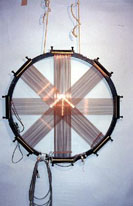
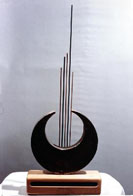
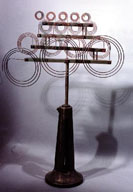
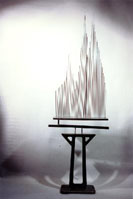
One of the most adventurous composers and performers of the Italian avant garde scene, member of the Gruppo di Improvvisazione Nuova Consonanza, great performer of the music of John Cage, Bertoncini started in the early ‘70s to design spectacular and visually fascinating “sound sculptures”, based on the aeolian sound principle.
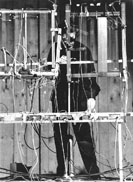
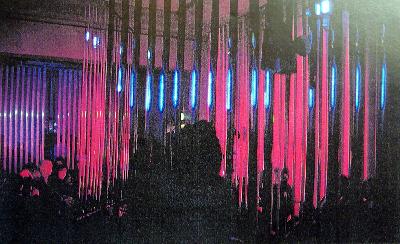
Amongst his more spectacular installations: Vele, a massive aeolian harps (more than 7 metres high); Venti (winds), for 20 aeolian sound generators and 40 performers; and Chanson pour Instruments à Vent, an “assemblage” for aeolian harps, aeolian gongs, and one performer.
His self-built harps and gongs are excited by blows of compressed air, or by the composer's own breath, and the resulting sound is amplified through contact microphones. If at superficial level they may sound like electronic music (long drones and swooshes of otherwordly sounds), at a close listening they reveal the intensity of a the pure and "mercurial" sound of air, far removed from any artificial or measurable principle. The CD presents the complete selection of his compositions for aeolian objects, from 1973 to more recent days.
The accompanying 196-pages book, in English and Italian and rich with photos, is a rather profound dissertation not only on the Aeolian harps, their generation and meaning, but also on experimental sound and music in general. Written by the composer in the form of a Platonic dialogue (between an old and bitter master and his young enthusiastic pupil), the book conveys not only a wealth of information on its subject matter, but also renders perfectly the voice full of wit of one of the most personal and uncompromising composers of the present times.
Chanson pour instruments à vent (1974) for harp and gongs operated by compressed air, conceived in 1973/74, the work includes an assembly of mechanical/electronic sound generators based on the principle of aeolian tones (a "sound sculpture") electronically amplified and excited in real time by only one player using his breathing and by utilizing four nozzles of compressed air of a discrete capacity (up to 1.5 bar). The use of the expression "sound sculpture" is nothing but a metaphoric image, as far as pitch, tone-colour and attack-mode are concerned (including the degree of limitation imposed on the instruments at the moment of their construction). This should never be confused with any visual or plastic installation in the proper sense of the word. In order to understand the piece correctly, I would suggest listening to it without any formalistic or dialectic preconceptions (for example, those related to rhythmical articulation); I would rather stress an appropriate concentration related to the subtle variations of colour connected with the modulation of the harmonic formants. The piece performed is exclusively due to the direct action of the interpreter over the above mentioned aeolian generators and, apart from electronic amplification, it does not make use of any electronic or digital manipulation.
BIO
Composer, pianist, musical constructivist Mario Bertoncini is a leading ficure of contemporary avant-garde music. He was born in Rome in 1932. From 1951 to 1961 he dedicated himself to classical and musical studies: composition with G. Petrassi and piano with R. Caporali in Rome; electronic music with G.M. Koenig in Utrecht. From 1956 he performs widely as concert pianist in Europe, as a soloist with orchestra (Bruno Maderna, Daniele Paris, Mario Rossi, Paul Hupperts, Roelof Krol and others) and in recitals. In 1962 he wins prize Nicola d'Atri (S. Cecilia National Academy) for SEI PEZZI PER ORCHESTRA and soon after he starts his first experiments with invented/prepared instruments (QUODLIBET, CIFRE, TUNE, SCRATCH-A-MATIC). And for QUODLIBET in 1965 he gains the prize of the Fondation europeènne de la Culture. From 1965 to 1973 he is one member of the Improvisation Group Nuova Consonanza and from '67 to '73 Music Theatre professor, working on functional interaction of sound and gestures (SPAZIO-TEMPO, ›Note per un teatro della realtà‹). In 1968 he works on EPITAFFIO: correspondence between the action of drawing and writing a text and its sonorous. While the world première of SPAZIO-TEMPO is held at Venice Biennale in 1970, while he is committed to the construction of his first sound objects on the principle of the Aeolian harp. From 1970 to '72 he is elected President of the contemporary music society Nuova Consonanza, and in 1974 he is invited to Berlin as »artist in residence« of the DAAD art program, where he realizes the first ambitious project of open air kinetic sound-sculptures (VELE, Berliner Festwochen).
In 1975-76 he gains associate professorship at the McGill University, Montréal where he helds an experimental composition course called ›Musical Design Course‹ and became founder of the MUD group, later known as SONDE. From 1980 (to 1997) he becomes professor at the Hochschule der Künste, Berlin. In 1986 he co-founded the theater group VIE with Matina Schaak and Roberto Capanna. In the same period, he invents an interactive system for the transformation of dance-gestures in optical and acoustic signals called ›Choreophon‹, while in 1992-93 he develops the ›Stabdämpfer‹ (bar mute), a special device for the preparation of stringed instruments and combines compositional work with performing activities as a pianist (works by Scarlatti, Schönberg, Stravinsky, Satie, Messiaen, Scelsi, John Cage, Terry Riley, Morton Feldman etc. and own arrangement: Earle Brown 4 SYSTEMS; Cage CARTRIDGE MUSIC). He is now back in Italy, but still really active with Concert/Lectures activities in Italy, but also Germany, USA, Canada, Europe, Korea, Israel…
Thursday, November 15, 2018
chimescape #411 / invented instruments #243
"Pierre Bastien - Air de Style Exquis A track from the album "Eggs Air Sister Steel". Released on the In-Poly-Sons label (IPS 10-94) in France in 1996. Composed and mixed by Pierre Bastien. This piece included the use of the Mecanium. "This is one of the inventions of the composer Pierre Bastien - a sixty-pieces orchestra made of Meccano parts, electro-motors and acoustic instruments from all over the world. According to the type of instrument that is included, each automaton plays a short melody, a rhythm or some harmony repeated in a loop."
Saturday, April 14, 2018
Subscribe to:
Posts (Atom)