Showing posts with label italy. Show all posts
Showing posts with label italy. Show all posts
Thursday, March 5, 2020

Tuesday, March 3, 2020
musica orale (liquimonofono)
"recorded in Torino, Italy, at the Studio di musica elettronica directed by Enore Zaffiri between 1965 and 1966. Poesia Liquida and Liquimofono, first experimental recordings, September 1968. The two recordings are here superimposed. The liquimofono was played and conceived by Piero Fogliati who also created the idromegafono. Previously issued as a book with a 7" record titled Il Liquimofono, Congegno Generatore Di Musica Liquida E La Poesia Liquida, Inflessioni Tuffate Nell'Idromegafono, in an edition of 1000 signed and numbered copies, published by Studio Di Informazione Estetica, Torino and Vanni Scheiwiller, Milano."
bonus orale
Friday, January 10, 2020
Hey, Luciani
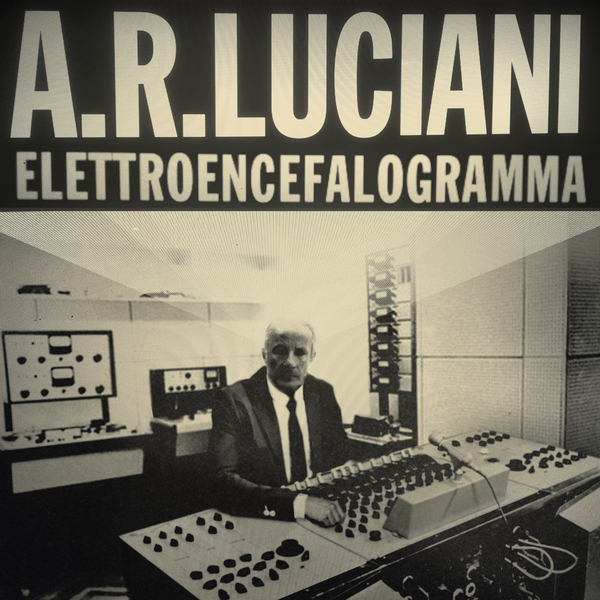
(via Bruce Levenstein)
https://boomkat.com/products/elettroencefalogramma
boomkat blurb:
‘Elettroencefalogramma’ scans the full breadth of solo experimental composition by Antonino Riccardo Luciani, revealing a strong, prescient, frankly shocking line in mind-bending, fathoms-deep work with tape and early, pre-synth devices. Awarded unprecedented access to the polymath composer’s archive of inter-disciplinary work, Andy Votel follows his pressing of Maria Teresa Luciani’s ‘Sounds of The City’ with this first compilation survey of her sibling’s vast catalogue. The set falls deep within the label’s remit of reissued and previously unreleased work by overlooked and undocumented pioneers of 20th century sound, revealing a distinctive mix of material that nods to contemporary, tape music, neo-classical, jazz, electro-acoustic and counterpoint composition.
Drawn from original tapes recorded during the 1970s, ‘Elettroencefalogramma’ spans the heyday of Luciani’s work, before synth music was popularised. In this sense it’s worth noting Luciani’s links with Teresa Rampazzi and the pioneering electroacoustic group NPS - and namely Serenella “Serena” Marega - with whom he shares a strong affiliation toward embracing the possibilities of new music at the dawn of an unprecedented sonic epoch. There’s a sense of being in transition between worlds and eras in the opening blend of melancholy strings and bubbling electronic rhythm ‘Battery Farm’, and likewise the cranky mixture of bestial growls and dissonance in ‘The Zoo’, while the rattly rhythm of ‘Offices’ uncannily recalls Trunk’s recent issue of ‘Mechanical Keyboard Sounds’ from the modern day. But Luciani excels at quieter, introspective styles, as with the flute-led vision of ‘Desol 2’, and most remarkably in the stygian, primitive drum machine pulse and clammy string drones of ‘Forest of Chimneys’, which is surely crying out for imagery of Satanic mills, while the rupturing tape of ‘Bombardment’ sets him firmly in a lane of advanced Italian noise that connects him to Gruppo’s Roland Kayn and Maurizio Bianchi.
Needless to say all of the material compiled here is taken from records that are incredibly rare and which were never intended for commercial release. It serves as a multifarious toolkit portfolio of Luciani’s most introspective, intimate, individualistic and uninhibited studio experiments - compiled and assembled in collaboration with the artist himself, whose vast and incredible oeuvre will hopefully now be made available to a new generation of listeners.
A.R. having a little moment, with this other reissue coming out last month:
release rationale:
The great fame of Antonino Riccardo Luciani, a musician and composer from Palermo, is due above all to his work for television and to one in particular, namely the music for the Almanacco del giorno dopo (Almanac of the Coming Day), a famous program that has been broadcast on the first channel of RAI - Italian Television for over twenty years. Chanson Balladée, this is the title, is for many people an indelible memory of a television now disappeared and radically changed, for which Luciani has often composed wonderful themes and soundtracks of great value as Tecnica di un colpo di stato (Technique of a coup d'état). Agonia della civiltà (Agony of Civilization), on the other hand, is part of his more experimental and abstract works, such as Inchiesta sul mondo (Inquiry Into the World) or Desol, and reveals the less accommodating side of the Sicilian composer, at work with tense atmospheres, hammering percussions, Musique concrète, magnificent orchestrations and bitter reflections on society. Originally released in 1972, the album is paradoxically more relevant in these complicated times. Titles such as Esodo di popolazioni (Exodus of Populations), Catastrofe sociale (Social Disaster), Disfacimento ecologico (Ecological Decay), Metropoli in agonia (Metropolis in Agony) o Dramma dell’evoluzione (Drama of Evolution) foretold our future almost fifty years in advance, accompanied by timeless music.
some other library bits and bobs by A.R. and aliases
love this cover
:format(jpeg):mode_rgb():quality(90)/discogs-images/R-1701933-1414677021-9007.jpeg.jpg)
:format(jpeg):mode_rgb():quality(90)/discogs-images/R-1701933-1440013962-5899.jpeg.jpg)
Thursday, January 17, 2019
Friday, November 23, 2018
Sunday, November 18, 2018
chimescape #43 / invented instruments #697
Mario Bertoncini – Arpe Eolie (Die Schachtel, 2007)
release rationale:
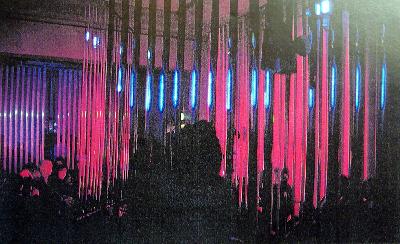
One of the most adventurous composers and performers of the Italian avant garde scene, member of the Gruppo di Improvvisazione Nuova Consonanza, great performer of the music of John Cage, Bertoncini started in the early ‘70s to design spectacular and visually fascinating “sound sculptures”, based on the aeolian sound principle.

Amongst his more spectacular installations: Vele, a massive aeolian harps (more than 7 metres high); Venti (winds), for 20 aeolian sound generators and 40 performers; and Chanson pour Instruments à Vent, an “assemblage” for aeolian harps, aeolian gongs, and one performer.
His self-built harps and gongs are excited by blows of compressed air, or by the composer's own breath, and the resulting sound is amplified through contact microphones. If at superficial level they may sound like electronic music (long drones and swooshes of otherwordly sounds), at a close listening they reveal the intensity of a the pure and "mercurial" sound of air, far removed from any artificial or measurable principle. The CD presents the complete selection of his compositions for aeolian objects, from 1973 to more recent days.
The accompanying 196-pages book, in English and Italian and rich with photos, is a rather profound dissertation not only on the Aeolian harps, their generation and meaning, but also on experimental sound and music in general. Written by the composer in the form of a Platonic dialogue (between an old and bitter master and his young enthusiastic pupil), the book conveys not only a wealth of information on its subject matter, but also renders perfectly the voice full of wit of one of the most personal and uncompromising composers of the present times.
Chanson pour instruments à vent (1974) for harp and gongs operated by compressed air, conceived in 1973/74, the work includes an assembly of mechanical/electronic sound generators based on the principle of aeolian tones (a "sound sculpture") electronically amplified and excited in real time by only one player using his breathing and by utilizing four nozzles of compressed air of a discrete capacity (up to 1.5 bar). The use of the expression "sound sculpture" is nothing but a metaphoric image, as far as pitch, tone-colour and attack-mode are concerned (including the degree of limitation imposed on the instruments at the moment of their construction). This should never be confused with any visual or plastic installation in the proper sense of the word. In order to understand the piece correctly, I would suggest listening to it without any formalistic or dialectic preconceptions (for example, those related to rhythmical articulation); I would rather stress an appropriate concentration related to the subtle variations of colour connected with the modulation of the harmonic formants. The piece performed is exclusively due to the direct action of the interpreter over the above mentioned aeolian generators and, apart from electronic amplification, it does not make use of any electronic or digital manipulation.


BIO
Composer, pianist, musical constructivist Mario Bertoncini is a leading ficure of contemporary avant-garde music. He was born in Rome in 1932. From 1951 to 1961 he dedicated himself to classical and musical studies: composition with G. Petrassi and piano with R. Caporali in Rome; electronic music with G.M. Koenig in Utrecht. From 1956 he performs widely as concert pianist in Europe, as a soloist with orchestra (Bruno Maderna, Daniele Paris, Mario Rossi, Paul Hupperts, Roelof Krol and others) and in recitals. In 1962 he wins prize Nicola d'Atri (S. Cecilia National Academy) for SEI PEZZI PER ORCHESTRA and soon after he starts his first experiments with invented/prepared instruments (QUODLIBET, CIFRE, TUNE, SCRATCH-A-MATIC). And for QUODLIBET in 1965 he gains the prize of the Fondation europeènne de la Culture. From 1965 to 1973 he is one member of the Improvisation Group Nuova Consonanza and from '67 to '73 Music Theatre professor, working on functional interaction of sound and gestures (SPAZIO-TEMPO, ›Note per un teatro della realtà‹). In 1968 he works on EPITAFFIO: correspondence between the action of drawing and writing a text and its sonorous. While the world première of SPAZIO-TEMPO is held at Venice Biennale in 1970, while he is committed to the construction of his first sound objects on the principle of the Aeolian harp. From 1970 to '72 he is elected President of the contemporary music society Nuova Consonanza, and in 1974 he is invited to Berlin as »artist in residence« of the DAAD art program, where he realizes the first ambitious project of open air kinetic sound-sculptures (VELE, Berliner Festwochen).
In 1975-76 he gains associate professorship at the McGill University, Montréal where he helds an experimental composition course called ›Musical Design Course‹ and became founder of the MUD group, later known as SONDE. From 1980 (to 1997) he becomes professor at the Hochschule der Künste, Berlin. In 1986 he co-founded the theater group VIE with Matina Schaak and Roberto Capanna. In the same period, he invents an interactive system for the transformation of dance-gestures in optical and acoustic signals called ›Choreophon‹, while in 1992-93 he develops the ›Stabdämpfer‹ (bar mute), a special device for the preparation of stringed instruments and combines compositional work with performing activities as a pianist (works by Scarlatti, Schönberg, Stravinsky, Satie, Messiaen, Scelsi, John Cage, Terry Riley, Morton Feldman etc. and own arrangement: Earle Brown 4 SYSTEMS; Cage CARTRIDGE MUSIC). He is now back in Italy, but still really active with Concert/Lectures activities in Italy, but also Germany, USA, Canada, Europe, Korea, Israel…
Sunday, October 7, 2018
Subscribe to:
Posts (Atom)